Captive Breeding Land Hermit Crabs
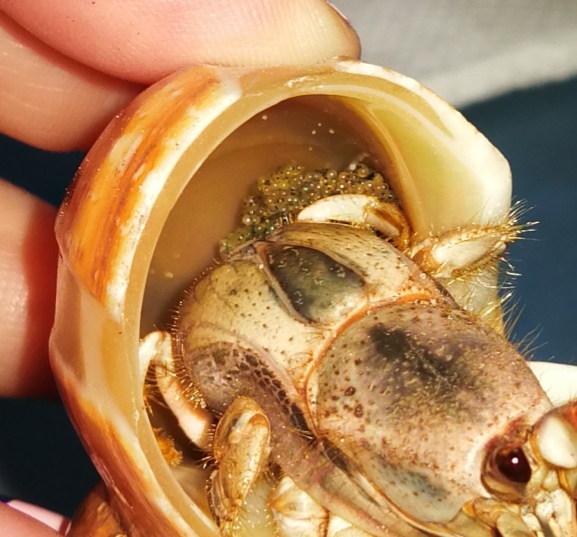
Healthy land hermit crabs can molt, grow, mate, and produce eggs in captivity. Raising their offspring is considerably more difficult. Land hermit crab larvae are aquatic, and a successful breeding project must support them through multiple larval stages before they metamorphose and transition to life on land.
Captive breeding has been accomplished by hobbyists around the world, but the process remains demanding. Breeders must provide appropriate marine conditions, frequent feeding, careful water management, and eventually a transition environment where megalopa can take shells and come to land.
Much of what hobbyists know about this process has been developed through years of individual breeding attempts and the sharing of those results. Stu Wools-Cobb was the first person known to raise captive-bred land hermit crabs to land outside a research laboratory and shared his methods so that other hobbyists could build upon his work.
Mary Akers began publicly documenting her breeding attempts in 2017 and went on to raise hundreds of captive-bred juveniles in successive breeding seasons. Her work helped establish a collaborative approach to captive breeding through the Hermit House Captive Breeding Project.
Captive Breeding Milestones
- The first C. clypeatus captive breeding was accomplished by Tammy Weick (United States) in 2008.
- The second C. clypeatus captive breeding was accomplished by Dany (Naalide Germany) in 2015.
- C. clypeatus captive breeding was accomplished by Mary Akers (United States) in 2018, 2019, 2020, and 2021.
- The first C. variabilis captive breeding was accomplished by Nat Addicted to HCs (Australia) in 2015.
- C. variabilis captive breeding was accomplished by Sue Brown (Australia) in 2016.
- The first C. violascens captive breeding was accomplished by Curlz (Germany) in 2012, then again in 2013 and 2015.
- The first C. purpureus captive breeding was accomplished by Curlz in 2015.
- The first C. lila (at the time believed to be C. purpureus) captive breeding was accomplished by Tammy Wiek (United States) in 2008.
- The second C. lila captive breeding was accomplished by Darcy Madsen in 2022.
- C. lila captive breeding was accomplished by Mary Akers in 2022.
- The first C. compressus captive breeding was accomplished by Mary Akers in 2020.
- The first C. perlatus captive breeding was accomplished by Mary Akers in 2022.
- The first second generation of captive-bred C. clypeatus was accomplished by Mary Akers in 2021.
- The first second generation of captive-bred hermit crabs (C. variabilis) was accomplished by Sue Brown (Australia) in 2021.
- C. clypeatus captive breeding was accomplished by Stacy Boltz (United States) in 2022.
- C. variabilis captive breeding was accomplished by Tiffany Boer (Australia) in 2022.
Mating, Eggs, and Spawning
Captive breeding begins with sexually mature hermit crabs mating and the female developing and carrying eggs. Female land hermit crabs carry their eggs attached to the pleopods beneath the abdomen until the eggs are mature enough to be released.
Mating behavior varies among Coenobita species. Breeders may observe mate guarding, shell rocking or tapping, and the male and female extending partially from their shells during mating. Some of these behaviors can resemble aggression or an attempt to take another crab’s shell, particularly to someone seeing them for the first time.
After mating, a gravid female carries the developing egg mass until she is ready to spawn. The existing record on this page describes an incubation period of approximately three to four weeks, with physiological and environmental conditions affecting the timing. landhermitcrabcaptivebreedingpr…
When the eggs are released into appropriate saltwater, the larvae hatch as free-swimming zoeae. This spawn marks the beginning of the aquatic larval-rearing stage of a captive breeding attempt.
The males will compete to mate with the female, with the dominant male guarding her against other males until she is ready to mate. Hermit crab mating and guarding behavior can be seen at All Things Crabby. The female may not be receptive to mating even though a male guards her. In some Coenobita species, other males may attempt to force the female to drop her eggs early so they can mate with her.
Mating occurs while still in the shell but with both hermit crab bodies extended so their abdomens are very close. Male hermit crabs have a large penis (relative to body size) to allow them to mate without leaving the safety of their shell. The male hermit crab rolls the female on the back of her shell and gently rocks her shell and strokes her legs. The female extends far enough so that the male can place his sex tubes on her gonophores (openings), then he deposits his spermatophore. Hermit crabs mating video – C. clypeatus Hermit crabs mating video – C. brevimanus
Some owners may confuse mating for an attempt to steal the female’s shell. C. rugosus has demonstrated a much more vigorous mating which can be alarming the first time an owner witnesses the behavior. Stacy Griffith reports that mating between her hermit crabs (species C. clypeatus and C. brevimanus) appeared very calm and might even be considered gentle.
The eggs are believed to be fertilized externally as they are extruded. Extrusion of hermit crab eggs can be seen at All Things Crabby.com. The female will carry her eggs until they are mature enough to spawn, typically 3-4 weeks, physiological and ecological factors will play a role in the duration of incubation. The female crab releases her eggs in or near the ocean where they hatch on contact with the ocean water.
From Zoea to Land
After hatching, the aquatic larvae—called zoeae—progress through a series of molts and developmental stages. The number of zoeal stages and the amount of time required varies among Coenobita species.

During this period, larvae must remain in suitable marine conditions. Captive breeders have used kreisel or similar circulating-water systems to keep the tiny larvae suspended in the water column. Frequent feeding and careful water management are required. Foods documented in captive breeding projects include Nannochloropsis, Marine Snow, decapsulated brine shrimp, live Artemia, and other phytoplankton and zooplankton.
Eventually, surviving zoeae metamorphose into megalopa. This is a critical transitional stage: the animal begins seeking an appropriately tiny gastropod shell and prepares for the transition from an aquatic larva to a terrestrial juvenile. Captive breeding records also document substantial cannibalism during the megalopa stage.
Once a megalopa has taken a shell, it can begin moving onto land. A dedicated transition environment provides access to both water and land while this occurs. After leaving the water and completing the transition to terrestrial life, the animal has reached the milestone captive breeders describe as making it to land. Historical breeding records show that this transition can occur over an extended period, with individuals from the same spawn reaching land on different days.
Learn From Captive Breeding Projects
Captive breeding methods have developed through breeders documenting their work and sharing what they learned. Historical and current breeding records can provide far more detail than a short overview of the process.
Mary Akers has publicly documented her captive breeding work since her first attempt in 2017, including detailed accounts of larval rearing and the transition to land.
Mary Akers — In the Crabitat
www.maryakers.com/inthecrabitat
Hermit Crab Breeding Attempt 3 — 2021
Hermit Crab Breeding Attempt 3 2021
Hermit Crab Breeding Attempt 4 — 2021
Hermit Crab Breeding Attempt 4 2021
How to Care for Baby Hermit Crabs
How to care for baby hermit crabs
Crab Central Station
Crab Central Station has documented captive breeding attempts and larval-rearing methods in video.
Support Captive Breeding
Captive breeding can help reduce reliance on wild-collected land hermit crabs while supporting the development and sharing of captive breeding knowledge.
Historical Breeding Record: Stu Wools-Cobb
The material below is preserved as part of the historical record of captive land hermit crab breeding.
In 2006, Stu Wools-Cobb shared his work on keeping and breeding land hermit crabs with Vanessa Pike-Russell. His account is especially significant because he was the first person known to raise captive-bred land hermit crabs to the terrestrial juvenile stage outside a research laboratory.
Stu gave Vanessa permission to share his work through Vanessa’s Crabitat and The Crab Street Journal. The original material includes specific restrictions on reproduction and remains the intellectual property of Stu Wools-Cobb. It is preserved here in accordance with that original permission.
Originally published October 12, 2006
Keeping and breeding land hermit crabs
Foreword:
Hello. My name is Vanessa Pike-Russell. Stu Wools-Cobb visited my website on land hermit crab care
and emailed me after reading my care sheet on gender and reproduction. At the time it had been unheard
of for land hermit crabs to have successfully reproduced in captivity and the resulting eggs raised to
juvenile (air-breathing) stage of development.
A few emails, phone calls later, and Stu sent me a copy of his booklet that was created in part for his
local aquarist society. Through his extensive background in breeding fish and raising brine shrimp he
was able to raise the hermit crab zoea with the materials he had on hand (see pages 10-12) and fed them
a diet rich in nutrients similar to those they would have access to in the inter tidal pools of the wild. A
steady routine of hand-feeding every two hours contributed to his success – and it is his desire to share
his knowledge and success with other land hermit crab enthusiasts with the hope that others will obtain
similar results.
Before you view this document, you are asked to be very mindful that it is for personal viewing only. Do not sell, re-sell, publish or distribute this booklet for commercial purposes. Any plagiarism of content contained within this booklet may result in legal action. All work remains the sole intellectual property of Stu Wools-Cobb and should not be used in any way without permission.
Stu Wools-Cobb has given written permission for Vanessa Pike-Russell of Vanessa’s Crabitat
(www.vanessascrabitat.com.au) permission to share this information on her site and on the magazine The Crab Street Journal of which she is a producer and webmaster. Any other use of this material is considered in breach of this agreement so please be very mindful of the terms on which it is shared.
A Method of Keeping and Breeding Land Hermit Crabs by Stu Wools-Cobb who has successfully bred and raised land hermit crab within his home.
Historical Research and Observation
Observations of Hermit Crab Mating
A hermit crab that is gravid (carrying eggs) will look like the drawing by Alcock, below. “A female crab attaches her eggs to the fine setae on her pleopods using a glue like substance.” (Fox, S. 2000)
Helfman (1997a) described the copulatory behaviour of B. latro from observation of a single event. Both male and female crabs were in intermolt phase during copulation. The male approaches the female slowly, clasps the dorsal meri of the chelipeds, and quickly moves forward to turn the female onto her back. Abdomens are extended, the male deposits the spermataphore, and the pair disengages.
The copulatory behaviour of other coenobitids apparently lasts much longer than for Birgus. Hazlett (1966) and De Wilde (1973) depicted the migration and reproductive behaviours of Coenobita clypeatus, but no copulatory activity was recorded. Observations of mating of C. clypeatus in the field, confirmed by the presence of a spermataphore on the female, have been made (S. Gilchrist, unpub). Initiation begins by the male grasping the aperture of the female’s shell and moving her shell from side to side. A series of rocking and tapping motions either stimulates the female to extend from the shell, in which case mating proceeds ventral to ventral, or the female retracts father into the shell and the male releases the shell. Page and Willason (1982) noted copulatory behaviour in C. perlatus. Mating occurs during migration to the sea proceeding larval release. Mating is ventral to ventral with both crabs about three-quarters out of their shells. Males pass the spermataphore to the females using the modified pereiopods. Mating may occur before release of the developed egg mass.”
(Dunham, D. W., and S. L. Gilchrist. 1988. p. 119)
Ovigerous females may be taking shelter at other points along this beach showing a cryptic habit during daylight and active at night as C. compressus, a common occurrence observed among ovigerous females of crustaceans; Particularly for C. scaevola and other coenobitids showed either daily or seasonal migrations depending upon rainfall. Also, spawning females of C. clypeatus presented an unusual pattern since they did not enter the water, but move toward the sea at low tide to drop or fling their eggs onto the wet rocks. (Shell utilization by the land hermit crab Coenobita scaevola from Wadi El-Gemal, Red Sea by Salam WS, Mantellato FL & Hanafy MH)
Captive Mating Observations
Coenobita clypeatus — August 2018
Stacy Griffith’s captive Coenobita clypeatus mating.
Coenobita brevimanus — May 2018
Stacy Griffith’s captive Coenobita brevimanus mating.
Farfinmosker
Captive breeding observations documented by the breeder known online as Farfinmosker. The surviving record of these breeding attempts consists of videos shared on YouTube.
Farfinmosker on YouTube
Hermit Crab Egg Fertilization
This reproductive observation was originally documented by Stacy Griffith on All Things Crabby in July 2018. The original site is no longer online, but the photographs and observations have been preserved by The Crab Street Journal.
References:
Brodie, R.J. 1998. Movements of the terrestrial hermit crab, Coenobita clypeatus (Crustacea, Coenobitidae). Revista de Biologia Tropical 46 (Suppl. 4): 181–185.
DeWilde, P. A. W. J. 1973. On the ecology of Coenobita clypeatus in Curaçao. Stud. Fauna Curaçao Other Caribb. Isl.144:1–138.
Dunham, D. W., and S. L. Gilchrist. 1988. Behavior. Pp. 97-138 in Biology of the Land Crabs, W. W. Burggren and B. R. McMahon, eds. Cambridge: Cambridge University Press.
Fletcher, W.J., Brown, I.W., Fielder, D.R., and Obed, A. 1991a.
Structure and dynamics of populations. Pp. 61–85 in: Brown, I.W.,
and Fielder, D.R. (eds), The coconut crab: aspects of Birgus latro
biology and ecology in Vanuatu. Canberra. Aciar Monographs 8.
Fletcher, W.J., Brown, I.W., Fielder, D.R., and Obed, A. 1991b. Moulting and growth characteristics. Pp. 35–60 in: Brown, I.W., and Fielder, D.R. (eds), The coconut crab: aspects of Birgus latro biology and ecology in Vanuatu. Canberra, Aciar Monographs 8.
Fox, S. Hermit Crabs: A Complete Owners Pet. Barron Books Pub.
Mamasaki, Matsuda, Takano, Sugizaki, Murakami, Dan, Kitada 2016. Thermal Adaptations of embryos of six terrestria hermit crab species
Hazlett, B.A., 1966. Social behavior of the Paguridae and Diogenidae of Curaçao. Studies on the Fauna of Curaçao and other Caribbean Islands, 23: pp.1-143
Hazlett, B.A. 1981. The behavioral ecology of hermit crabs. Annual Review of Ecology and Systematics 12: 1–22.
Helfman, G. S. 1973. Ecology and Behaviour of the Coconut Crab, Birgus latro (L). Masters thesis, University of Hawaii, Honolulu.
Hicks, J., H. Rumpff, and H. Yorkston. 1990. Christmas Crabs., Golden Earth Design and Printing, Singapore.
Gray, H. S. 1995. Christmas Island Naturally., Scott Four Colour Print, Perth, Western Australia. Pp. 11–145.
Harvey, A. Text from a personal email to Vanessa Pike-Russell from Alan Harvey regarding determining the gender of a land hermit crab. Shared with permission. For more information about Alan Harvey and his research, please visit the link below
http://www.bio.gasou.edu/bio-home/harvey/research.html
Jones, S. and Morgan, G.J. (1994) A Field Guide to Crustaceans of Australian Waters. Western Australian Museum. Chatswood, N.S.W. (Australia) : Reed Books, 1994. ISBN 0 7301 0403 6
Lowry, J.K. (1999 onwards). ‘Crustacea, the Higher Taxa: Description, Identification, and Information Retrieval.’ Version: 2 October 1999. http://crustacea.net/
Morgan, S. G., and J. H. Christy. 1995. Adaptive significance of the timing of larval release by crabs. Am. Nat.145:457–479.
Nakasone, 2001
Sato & Yoseda, 2008
Page, H.M., and Willason, 1982. Distribution Patterns of terrestrial hermit crabs at Enewetak Atoll, Marshall Islands. Pacific Sci. 36:107-117
Vannini, M., and G. Chelazzi. 1981. Orientation of Coenobita rugosus (Crustacea: Anomura): A field study on Aldabra. Mar. Biol.64:135–140.
Vannini, M., and S. Cannicci. 1995. Homing behaviour and possible cognitive maps in crustacean decapods. J. Exp. Mar. Biol. Ecol.193:67–91.
Wolcott, T. G. 1988. Ecology. Pp. 55-96 in: Biology of Land Crabs (W. Burggren and B. McMahon, Eds.), Cambridge University Press, New York.
*Dorothy Bliss writes “In, pagurid anomurans, such as the king crab and hermit crabs, the postlarvae is called a glaucothoe. …the postlarva of brachyuran crab has its own distinctive name, megalops-or megalopa.” Megalopa is commonly used in place of glaucothoe by breeders today so I’ve opted to use that term as well.